
Article · 2 September 2026
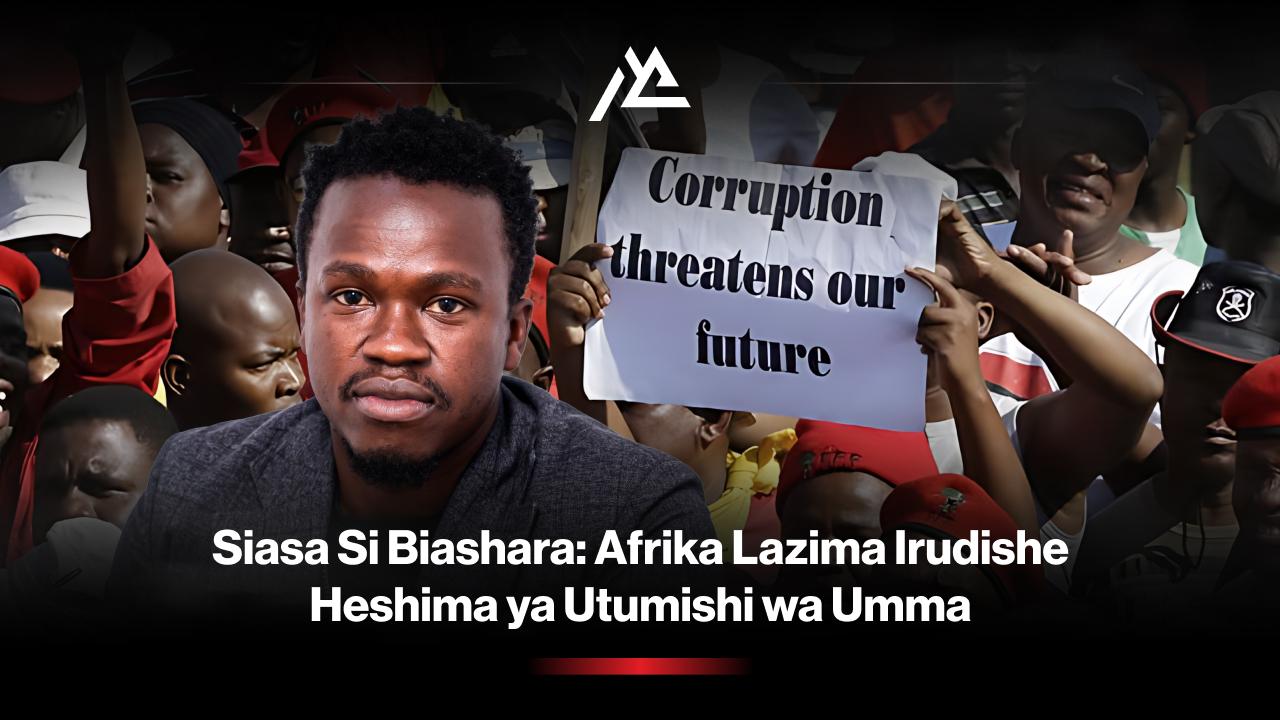
Politics Is Not a Business: Africa Must Restore the Dignity of Public Service
Politics is not a business; it is a responsibility to serve people. When leaders treat political office as an investment to recover, corruption and conflicts of interest become inevitable. Africa needs leaders who put public service above personal gain, protect public resources and measure their success not by what they accumulate, but by the lives they improve and the legacy they leave for the next generation.
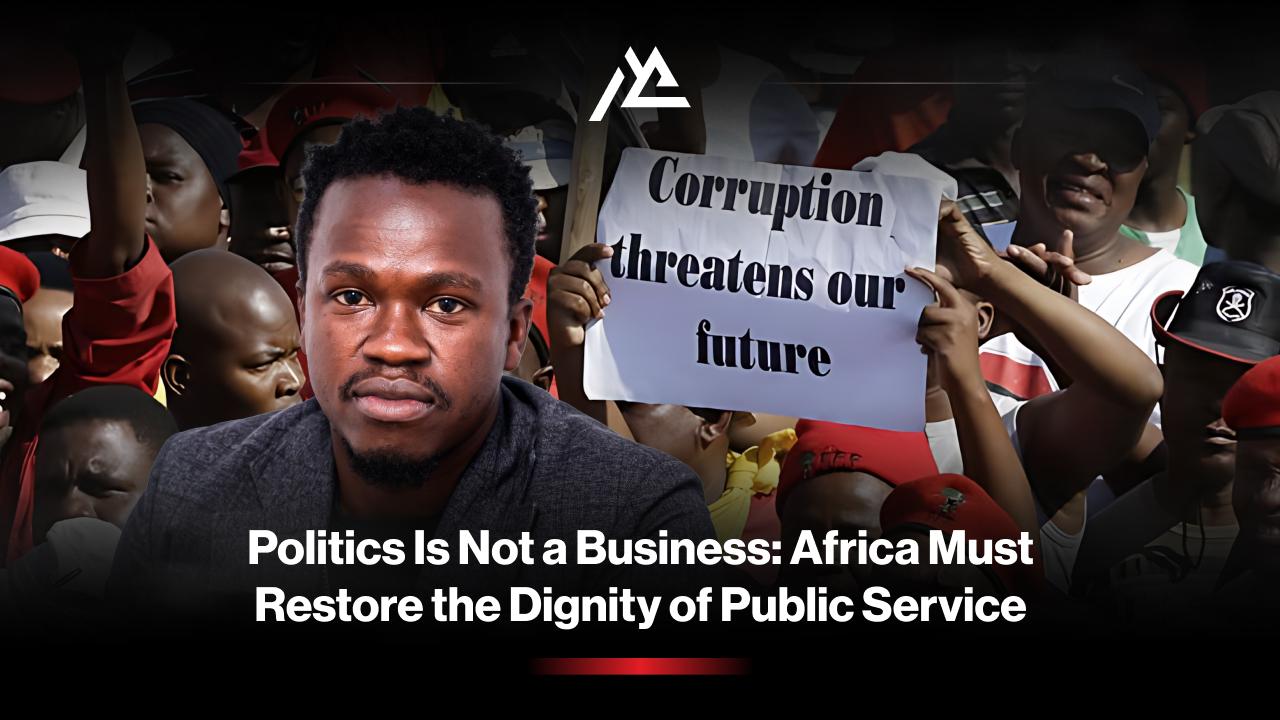
Politics Is Not a Business: Africa Must Restore the Dignity of Public Service
What happens when politicians begin to think like businessmen?
They calculate investments, measure returns and look for ways to recover what they have spent. In business, that logic is legitimate. In politics, it can be dangerous.
Across Africa and beyond, politics is increasingly being treated as an investment rather than a responsibility. Candidates spend enormous amounts of money to win elections, build political networks, reach voters and secure positions of influence. Once they enter office, however, a difficult question can emerge: How do I recover what I invested?
That is where corruption can begin—not always with a bribe, but with a mindset.
Politics was never meant to operate according to the principles of a commercial enterprise. Business is built around investment, risk and return. An entrepreneur puts capital into an idea, develops a product or service, attracts customers and expects to make a profit. The greater the investment, the greater the expectation of financial return.
Public leadership is fundamentally different.
When a person enters politics, they are not investing in a government position. They are accepting a responsibility on behalf of other people. They are being entrusted with public resources, public institutions and, ultimately, the hopes and aspirations of citizens.
That distinction matters because politics is not something that happens somewhere far away from ordinary people. Politics is our daily life. It determines the quality of our schools, hospitals, roads, economies, security systems and justice institutions. Political decisions influence whether young people find jobs, whether businesses can grow, whether families can live with dignity and whether communities have access to basic services.
Politics can therefore become a matter of life and death.
When the right people enter political office, societies can experience progress, stability and hope. When the wrong people enter those offices, millions can suffer. Poor political leadership can produce unemployment, poverty, corruption, weak institutions, failing public services and lost opportunities for an entire generation.
That is why it is so dangerous when political office begins to look like a business opportunity.
When Elections Become Investments
Perhaps nowhere is this transformation more visible than during election campaigns.
Election seasons often bring an enormous circulation of money into communities. Candidates spend heavily on transportation, rallies, advertising, media, campaign staff, political organization and voter mobilization. In some environments, financial incentives also become part of the competition for political support.
Money can certainly be necessary to run a modern political campaign. The problem begins when money becomes the principal measure of political strength and candidates begin to see the election itself as an investment.
The logic becomes dangerously simple: I have spent this much to obtain political power; therefore, once I have power, I must find a way to recover what I spent.
But public office cannot be a mechanism for recovering private investments.
Once that mindset takes hold, government contracts can become opportunities for personal enrichment. Public resources can become tools for private accumulation. Political influence can become a personal asset. The office that was created to serve society can gradually become an instrument for serving the individual who occupies it.
The greater the investment in obtaining political power, the greater the temptation may become to extract value from that power.
This is how the cycle of corruption can become self-perpetuating.
Citizens Are Not Customers
The commercialization of politics also changes how politicians perceive the people they represent.
Instead of asking, “What kind of society can we build together?” the political mindset can become, “What can I give these people so that they will vote for me?”
That is a fundamental difference.
A citizen is not a customer, and government is not a company.
A politician should not have to purchase the loyalty of citizens. Citizens should be able to evaluate leaders based on their character, competence, ideas, integrity and vision for the country.
Giving someone money during an election may win a vote today, but it does not necessarily create prosperity tomorrow. A temporary handout cannot replace a functioning economy. A campaign gift cannot replace employment. A political promise cannot substitute for a good education system. A rally cannot build a hospital.
People deserve more than election-season generosity. They deserve systems that allow them to prosper long after the campaign posters have been removed.
Businesspeople Can Lead—But Conflicts of Interest Matter
None of this means that successful businesspeople should be excluded from politics.
In fact, entrepreneurs and professionals can bring valuable experience into public leadership. Someone who has built a company may understand investment, job creation, markets, technology, management and economic development in ways that can benefit government.
The issue is not whether a politician has a business background.
The issue is whether private interests can be separated from public responsibility.
When a public official directly controls a business that can benefit from government decisions, the potential for a conflict of interest is obvious. A politician should not be in a position where the power of the state can be used to advance a personal commercial interest.
This is why strong conflict-of-interest rules, transparent asset declarations, independent oversight and effective accountability institutions are so important.
Where necessary, public officials should remove themselves from the direct management of businesses and ensure that their private interests cannot influence the decisions they make in public office.
The purpose is not to punish successful people.
The purpose is to protect public trust.
Leadership Is Sacrifice
Perhaps we have also misunderstood what political leadership is supposed to mean.
A public office is not simply a chair. It is not a title. It is not a pathway to personal wealth. It is not a reward for winning an election.
It is a responsibility.
True leadership requires sacrifice because leadership is ultimately about carrying the burdens of other people.
A leader must sometimes make decisions that are personally costly but beneficial to society. A leader must protect public resources even when there are opportunities to benefit personally. A leader must sometimes make decisions that are unpopular today because they will create a better future tomorrow.
That is what makes leadership different from business.
In business, success is often measured by profit. In public service, success should be measured by impact.
How many lives became better?
How many children received a better education?
How many young people found meaningful employment?
How many families gained access to healthcare?
How much stronger did the country’s institutions become?
How much more hopeful did the next generation become?
These are the returns that should matter in leadership.
The Real Test Begins After the Election
The real test of a politician does not begin when they win an election.
It begins the morning after.
The campaign crowds disappear. The speeches end. The posters come down. The music stops. The politician is left with the responsibility that millions of people have entrusted to them.
At that moment, the most important question should not be, “How much did I spend to get here?”
It should be:
“What can I do with this responsibility to make people’s lives better?”
That is the question that separates public servants from political entrepreneurs.
A politician can spend millions to win an election, but money cannot purchase wisdom. It cannot purchase integrity. It cannot purchase character. It cannot guarantee that someone will have the courage to put the public interest above personal gain.
Winning an election is not the ultimate achievement of leadership.
Serving people well is.
Africa Has an Opportunity
This is not exclusively an African problem. Political corruption, conflicts of interest and the influence of money on elections exist in democracies across the world.
But Africa has a unique opportunity to build a different political culture for the generations that are coming.
The continent is home to one of the world’s youngest populations. Millions of young Africans are watching today’s leaders and learning from what they see. If they repeatedly see politics associated with corruption, wealth accumulation and abuse of power, they may eventually conclude that politics itself is inherently corrupt.
We should not leave that legacy for them.
We should show young Africans that politics can be honorable, that public office can be dignified and that leadership can still be an expression of service rather than personal ambition.
We need leaders who understand that their greatest achievement will not be the wealth they accumulate while in office, but the institutions they strengthen and the lives they improve.
A school that continues educating children after a leader leaves office is a legacy.
A hospital that continues saving lives is a legacy.
An economy that continues creating jobs is a legacy.
An institution that remains strong regardless of who occupies political office is a legacy.
A generation that believes government can be trusted is perhaps the greatest legacy of all.
A Choice for Those Who Want to Lead
To African leaders, and to those who aspire to lead in the future, my message is simple: please make it right.
Do not treat politics as a business. Do not treat citizens as your clients. Do not enter public office thinking first about what you can recover, accumulate or control.
Enter because you are willing to serve.
Enter because you are willing to sacrifice.
Enter because you believe the lives of other people can become better because you accepted the responsibility to lead them.
There is nothing wrong with building a business. There is nothing wrong with creating wealth. There is nothing wrong with entrepreneurship. Africa needs entrepreneurs, investors and businesses that create jobs, build industries and generate prosperity.
But we must be extremely careful when private financial interests become intertwined with public authority.
At some point, every leader must decide whom they are ultimately serving: themselves or the people.
When those interests come into conflict, they cannot both come first.
Politics Is Service
Politics is too important to be reduced to an investment strategy.
Leadership is too important to be reduced to a title.
Public office is too important to become a mechanism for personal enrichment.
Leadership is service.
And service is not measured by what you take from people, but by what you are willing to give so that their lives—and the lives of the generations that come after them—can become better.
Africa does not simply need more politicians who know how to win elections. Africa needs leaders who understand how to serve people.
Perhaps Africa’s greatest political opportunity is not simply to develop faster economies or stronger institutions, but to restore the moral meaning of leadership itself.
We can choose to raise a generation that sees politics as corrupt, transactional and self-serving, or we can build a political culture in which public office is once again associated with integrity, sacrifice and service.
The choice is ours.
And perhaps Africa can lead the way.
Politics is not a business. Leadership is not a business. Public office is not an investment vehicle.
Leadership is service.
And the greatest return a leader can receive is not what they accumulate for themselves, but what they leave behind for the people they were entrusted to serve.
Mika Chavala
What happens when politicians begin to think like businessmen?
They calculate investments, measure returns and look for ways to recover what they have spent. In business, that logic is legitimate. In politics, it can be dangerous.
Across Africa and beyond, politics is increasingly being treated as an investment rather than a responsibility. Candidates spend enormous amounts of money to win elections, build political networks, reach voters and secure positions of influence. Once they enter office, however, a difficult question can emerge: How do I recover what I invested?
That is where corruption can begin—not always with a bribe, but with a mindset.
Politics was never meant to operate according to the principles of a commercial enterprise. Business is built around investment, risk and return. An entrepreneur puts capital into an idea, develops a product or service, attracts customers and expects to make a profit. The greater the investment, the greater the expectation of financial return.
Public leadership is fundamentally different.
When a person enters politics, they are not investing in a government position. They are accepting a responsibility on behalf of other people. They are being entrusted with public resources, public institutions and, ultimately, the hopes and aspirations of citizens.
That distinction matters because politics is not something that happens somewhere far away from ordinary people. Politics is our daily life. It determines the quality of our schools, hospitals, roads, economies, security systems and justice institutions. Political decisions influence whether young people find jobs, whether businesses can grow, whether families can live with dignity and whether communities have access to basic services.
Politics can therefore become a matter of life and death.
When the right people enter political office, societies can experience progress, stability and hope. When the wrong people enter those offices, millions can suffer. Poor political leadership can produce unemployment, poverty, corruption, weak institutions, failing public services and lost opportunities for an entire generation.
That is why it is so dangerous when political office begins to look like a business opportunity.
When Elections Become Investments
Perhaps nowhere is this transformation more visible than during election campaigns.
Election seasons often bring an enormous circulation of money into communities. Candidates spend heavily on transportation, rallies, advertising, media, campaign staff, political organization and voter mobilization. In some environments, financial incentives also become part of the competition for political support.
Money can certainly be necessary to run a modern political campaign. The problem begins when money becomes the principal measure of political strength and candidates begin to see the election itself as an investment.
The logic becomes dangerously simple: I have spent this much to obtain political power; therefore, once I have power, I must find a way to recover what I spent.
But public office cannot be a mechanism for recovering private investments.
Once that mindset takes hold, government contracts can become opportunities for personal enrichment. Public resources can become tools for private accumulation. Political influence can become a personal asset. The office that was created to serve society can gradually become an instrument for serving the individual who occupies it.
The greater the investment in obtaining political power, the greater the temptation may become to extract value from that power.
This is how the cycle of corruption can become self-perpetuating.
Citizens Are Not Customers
The commercialization of politics also changes how politicians perceive the people they represent.
Instead of asking, “What kind of society can we build together?” the political mindset can become, “What can I give these people so that they will vote for me?”
That is a fundamental difference.
A citizen is not a customer, and government is not a company.
A politician should not have to purchase the loyalty of citizens. Citizens should be able to evaluate leaders based on their character, competence, ideas, integrity and vision for the country.
Giving someone money during an election may win a vote today, but it does not necessarily create prosperity tomorrow. A temporary handout cannot replace a functioning economy. A campaign gift cannot replace employment. A political promise cannot substitute for a good education system. A rally cannot build a hospital.
People deserve more than election-season generosity. They deserve systems that allow them to prosper long after the campaign posters have been removed.
Businesspeople Can Lead—But Conflicts of Interest Matter
None of this means that successful businesspeople should be excluded from politics.
In fact, entrepreneurs and professionals can bring valuable experience into public leadership. Someone who has built a company may understand investment, job creation, markets, technology, management and economic development in ways that can benefit government.
The issue is not whether a politician has a business background.
The issue is whether private interests can be separated from public responsibility.
When a public official directly controls a business that can benefit from government decisions, the potential for a conflict of interest is obvious. A politician should not be in a position where the power of the state can be used to advance a personal commercial interest.
This is why strong conflict-of-interest rules, transparent asset declarations, independent oversight and effective accountability institutions are so important.
Where necessary, public officials should remove themselves from the direct management of businesses and ensure that their private interests cannot influence the decisions they make in public office.
The purpose is not to punish successful people.
The purpose is to protect public trust.
Leadership Is Sacrifice
Perhaps we have also misunderstood what political leadership is supposed to mean.
A public office is not simply a chair. It is not a title. It is not a pathway to personal wealth. It is not a reward for winning an election.
It is a responsibility.
True leadership requires sacrifice because leadership is ultimately about carrying the burdens of other people.
A leader must sometimes make decisions that are personally costly but beneficial to society. A leader must protect public resources even when there are opportunities to benefit personally. A leader must sometimes make decisions that are unpopular today because they will create a better future tomorrow.
That is what makes leadership different from business.
In business, success is often measured by profit. In public service, success should be measured by impact.
How many lives became better?
How many children received a better education?
How many young people found meaningful employment?
How many families gained access to healthcare?
How much stronger did the country’s institutions become?
How much more hopeful did the next generation become?
These are the returns that should matter in leadership.
The Real Test Begins After the Election
The real test of a politician does not begin when they win an election.
It begins the morning after.
The campaign crowds disappear. The speeches end. The posters come down. The music stops. The politician is left with the responsibility that millions of people have entrusted to them.
At that moment, the most important question should not be, “How much did I spend to get here?”
It should be:
“What can I do with this responsibility to make people’s lives better?”
That is the question that separates public servants from political entrepreneurs.
A politician can spend millions to win an election, but money cannot purchase wisdom. It cannot purchase integrity. It cannot purchase character. It cannot guarantee that someone will have the courage to put the public interest above personal gain.
Winning an election is not the ultimate achievement of leadership.
Serving people well is.
Africa Has an Opportunity
This is not exclusively an African problem. Political corruption, conflicts of interest and the influence of money on elections exist in democracies across the world.
But Africa has a unique opportunity to build a different political culture for the generations that are coming.
The continent is home to one of the world’s youngest populations. Millions of young Africans are watching today’s leaders and learning from what they see. If they repeatedly see politics associated with corruption, wealth accumulation and abuse of power, they may eventually conclude that politics itself is inherently corrupt.
We should not leave that legacy for them.
We should show young Africans that politics can be honorable, that public office can be dignified and that leadership can still be an expression of service rather than personal ambition.
We need leaders who understand that their greatest achievement will not be the wealth they accumulate while in office, but the institutions they strengthen and the lives they improve.
A school that continues educating children after a leader leaves office is a legacy.
A hospital that continues saving lives is a legacy.
An economy that continues creating jobs is a legacy.
An institution that remains strong regardless of who occupies political office is a legacy.
A generation that believes government can be trusted is perhaps the greatest legacy of all.
A Choice for Those Who Want to Lead
To African leaders, and to those who aspire to lead in the future, my message is simple: please make it right.
Do not treat politics as a business. Do not treat citizens as your clients. Do not enter public office thinking first about what you can recover, accumulate or control.
Enter because you are willing to serve.
Enter because you are willing to sacrifice.
Enter because you believe the lives of other people can become better because you accepted the responsibility to lead them.
There is nothing wrong with building a business. There is nothing wrong with creating wealth. There is nothing wrong with entrepreneurship. Africa needs entrepreneurs, investors and businesses that create jobs, build industries and generate prosperity.
But we must be extremely careful when private financial interests become intertwined with public authority.
At some point, every leader must decide whom they are ultimately serving: themselves or the people.
When those interests come into conflict, they cannot both come first.
Politics Is Service
Politics is too important to be reduced to an investment strategy.
Leadership is too important to be reduced to a title.
Public office is too important to become a mechanism for personal enrichment.
Leadership is service.
And service is not measured by what you take from people, but by what you are willing to give so that their lives—and the lives of the generations that come after them—can become better.
Africa does not simply need more politicians who know how to win elections. Africa needs leaders who understand how to serve people.
Perhaps Africa’s greatest political opportunity is not simply to develop faster economies or stronger institutions, but to restore the moral meaning of leadership itself.
We can choose to raise a generation that sees politics as corrupt, transactional and self-serving, or we can build a political culture in which public office is once again associated with integrity, sacrifice and service.
The choice is ours.
And perhaps Africa can lead the way.
Politics is not a business. Leadership is not a business. Public office is not an investment vehicle.
Leadership is service.
And the greatest return a leader can receive is not what they accumulate for themselves, but what they leave behind for the people they were entrusted to serve.
Mika Chavala

Comments
Join the conversation. You can comment anonymously.
Loading comments…