
Article · 29 October 2026
One Year After My Arrest: Mika Chavala Reflects on 35 Days in Prison, His Family’s Pain and the Power of Faith
One year after being arrested and charged with treason in Tanzania, Mika Lucas Chavala reflects on his 35 days in prison, his family’s suffering, and the faith that sustained him. Following the withdrawal of the charges, he expresses gratitude to God and everyone who supported his release, while remembering those who lost their lives during the post-election unrest and calling for justice for those still behind bars.
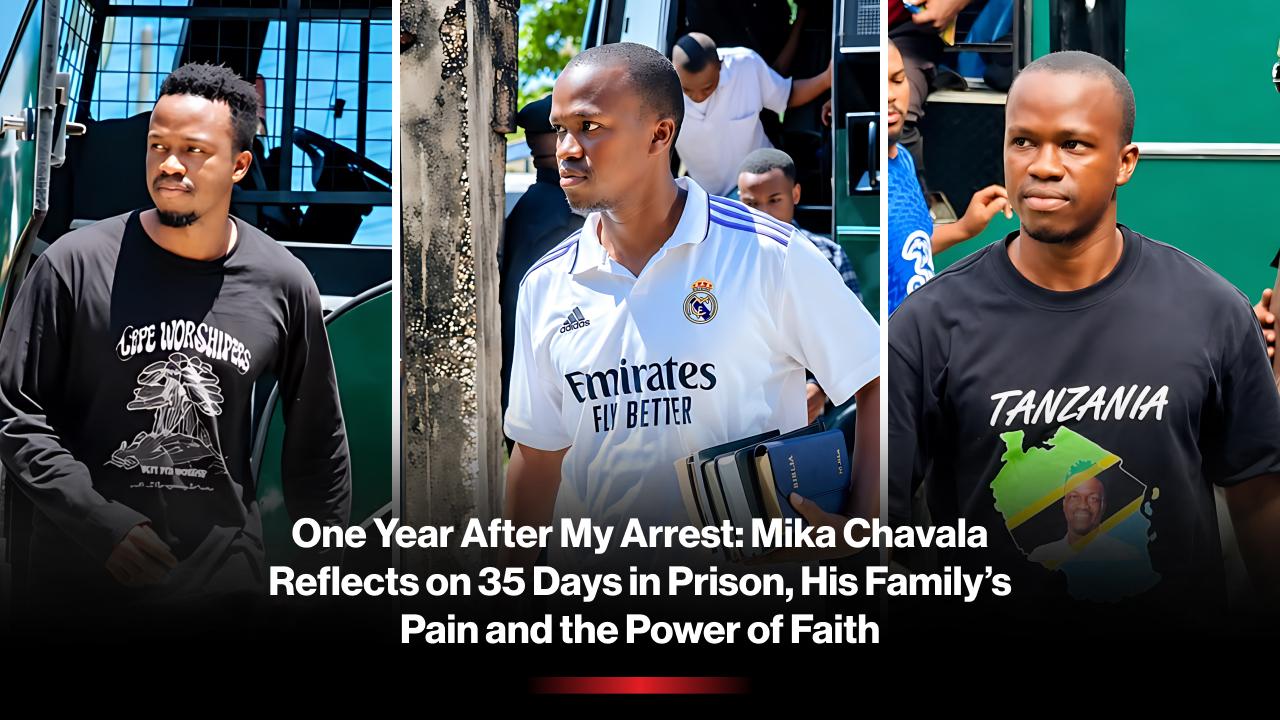
Dodoma, Tanzania | October 29, 2026
One year after his arrest on treason charges during Tanzania’s post-election unrest, Tanzanian entrepreneur and media personality Mika Lucas Chavala reflects on imprisonment, the suffering of his family, the solidarity that helped sustain him, and his continued call for justice for those who remain behind bars.
On October 29, 2025, my life changed in ways I could never have imagined.
I was arrested and taken into custody during a period of intense political unrest in Tanzania. A few days later, I was brought before a court and charged with treason, one of the most serious criminal accusations a person can face.
For the next 35 days, I remained in prison, uncertain about what the future held. On December 3, 2025, the prosecution withdrew the case against me, and I walked out of court a free man.
One year later, I am alive to tell my story. But this is not simply a story about my arrest or release. It is a story about family, faith, the fragility of freedom, the power of solidarity, and the human cost of political turmoil.
When Everything Fell Apart
Before my arrest, I had dreams, ambitions, businesses to build, and a future I was working towards. Like many young Africans, I believed that through hard work, ideas, and determination, I could contribute to the development of my country and continent. Then, almost overnight, everything changed.
My reputation was under pressure, my future became uncertain, and the life I had worked to build felt as though it had been shattered. There were moments when I wondered what would remain of me after the experience.
Prison took away my freedom of movement, but the uncertainty extended far beyond the prison walls. My family was left to navigate fear, unanswered questions, and the emotional burden of not knowing what would happen to me.
I have come to understand that when one person is detained, an entire family can suffer alongside them.
The Pain My Parents Endured
Perhaps the most painful part of this experience was not what happened to me, but what my parents went through while I was away.
Recently, I learned more about the depth of their suffering. My parents reached out to people they believed might be able to help, hoping that someone would stand with our family during its darkest hour. Some people chose to walk away quietly. Others distanced themselves from my parents because of what had happened to me.
For a family already struggling with fear and uncertainty, that isolation added another layer of pain.
Yet a few people stood firm. They supported my family, raised their voices, and helped sustain the fight for my release. Their courage reminded me that genuine friendship is often revealed not when life is comfortable, but when standing beside someone comes at a cost.
The consequences for my family did not end when I was released.
After I returned home, my mother became seriously ill, and we feared that we might lose her. When we sought medical attention, we were told that her condition was linked to the pain and overwhelming stress she had experienced while I was missing.
That experience left a mark on me that words can hardly explain.
I had been counting the days until I could return home, but I had not fully understood the emotional price my parents were paying while waiting for me.
My release brought relief, but it could not immediately erase the fear, anxiety, and suffering that my family had endured.
Behind every person in detention is a human story. Sometimes, the people who suffer most are those waiting outside the prison gates.
The Voices That Refused to Be Silent
During those difficult weeks, many Tanzanians raised their voices in support of my release. People spoke about my case online, expressed concern, prayed for me, and stood with my family. Messages of support also came from friends and well-wishers beyond Tanzania’s borders.
I may never be able to identify or personally thank every individual who played a part in that solidarity. But I want them to know that their actions mattered.
To those who spoke when silence would have been easier, to those who prayed when there appeared to be little they could do, and to those who stood beside my parents when they felt abandoned, I remain deeply grateful.
Your support reminded me that a person can be physically isolated and yet not entirely alone.
My experience also reinforced something important: freedom, justice, and human dignity are not concerns that should matter only when they affect us personally. They are principles that require the attention and protection of society as a whole.
Remembering Those Who Never Came Home
As I reflect on this anniversary, I cannot speak about my own survival without remembering those who lost their lives during the post-election violence.
Tanzania’s October 2025 election period was marked by widespread protests, deadly confrontations, arrests, and serious concerns about the use of force. International reporting documented the unrest and calls for investigations into reported deaths and alleged human rights violations. Human Rights Watch, in its October 28, 2026 assessment, said families of people killed or missing were still awaiting answers and accountability. Read the report.
Behind every reported death is a person who had a name, a family, a future, and people who loved them.
There are parents who still wait for answers, children growing up without a mother or father, and families who continue to carry grief that no public statement can resolve.
Sometimes I ask myself a question that I may never fully answer: Who am I that I am still alive today when so many others lost their lives?
I do not ask this because I believe my life is more valuable than theirs. I ask because surviving an experience in which others suffered and died brings a profound awareness of how fragile life is.
My survival is not a reason to forget those who died. It is a reason to remember them, to pray for their families, and to insist that their lives must not become forgotten statistics.
I believe their families deserve answers, credible investigations, and justice.
Faith in the Middle of the Storm
Throughout my imprisonment and the uncertainty surrounding my future, my Christian faith remained central to how I understood what I was experiencing.
There were questions I could not answer, circumstances I could not control, and outcomes I could not predict. In those moments, I turned to God.
Today, I look back and see the hand of God in my survival.
If it were not for His protection, the prayers of believers, the solidarity of my fellow Tanzanians, and the support of friends across the world, I often wonder where I would be today.
Above all, I cannot tell my story without acknowledging the mercy and grace of my Lord and King, Jesus Christ.
My faith does not mean that I have forgotten the pain or that I have all the answers. It means that, even in the face of uncertainty, I have found a reason to remain grateful and hopeful.
I have learned that gratitude and grief can exist together. I can thank God for preserving my life while mourning those who lost theirs. I can celebrate my freedom while remembering those who remain detained. I can acknowledge the kindness of those who stood with me while recognizing the pain caused by those who walked away.
For me, faith is not a denial of suffering. It is the strength to continue living, loving, praying, and hoping despite it.
Freedom Must Mean More Than One Person’s Release
Although I am grateful to be free, my heart is not fully at rest.
There are others who remain behind bars, and there are families still waiting for answers about their loved ones. I stand in solidarity with those who believe they have been unjustly detained and with everyone seeking a fair hearing, due process, and justice.
I do not want my freedom to become the end of the conversation.
My experience has made me more conscious of the importance of protecting human dignity, ensuring access to justice, and creating conditions in which people can express their views peacefully without fear of unlawful punishment.
A society’s commitment to justice should be measured not only by how it treats those whose freedom is never threatened, but also by how it treats people accused of wrongdoing, including those whose cases have not yet been fairly determined.
Every person deserves due process. Every family deserves to be treated with dignity. Allegations of unlawful conduct and human rights violations deserve credible investigation, and those responsible for wrongdoing should be held accountable through fair legal procedures.
These principles are not the property of any one political party, movement, or individual. They are essential to the dignity of every human being.
My hope is that Tanzania will continue working towards a future in which differences can be addressed peacefully, justice is accessible to all, and no family has to endure the kind of uncertainty mine experienced.
A Year Later, I Choose Gratitude
One year ago, I could not have known what the next chapter of my life would look like.
Today, I am still here. I am rebuilding, continuing my work, and moving forward with a deeper appreciation for life and the people who make it meaningful.
My experience has taught me that a person’s worth cannot be measured by the darkest chapter of their life. It has taught me that reputation can be challenged, plans can be interrupted, and circumstances can change in a moment. It has also taught me that kindness, courage, and faith can sustain people through extraordinary hardship.
To everyone who prayed for me, spoke on my behalf, supported my family, and refused to let my story be forgotten, I offer my sincere gratitude.
To my parents, who endured a pain I am still learning to understand, I owe a debt of love that words can never fully repay.
To the families who lost loved ones, my heart remains with you.
And to those who are still behind bars and the families waiting for their return, you have not been forgotten.
I cannot change what happened a year ago. But I can choose what I do with the life I have been given.
I choose gratitude. I choose faith. I choose to remember. And I choose to keep speaking about freedom, justice, and the dignity of every human being.
SITASAHAU. SIWEZI SAHAU.
Wema umenitendea, umenipendelea.
I will not forget. I cannot forget. You have shown me kindness; You have favoured me.
To God be all the glory, forever and ever.
Amen.
Keep reading

Comments
Join the conversation. You can comment anonymously.
Loading comments…