
Article · 29 September 2026
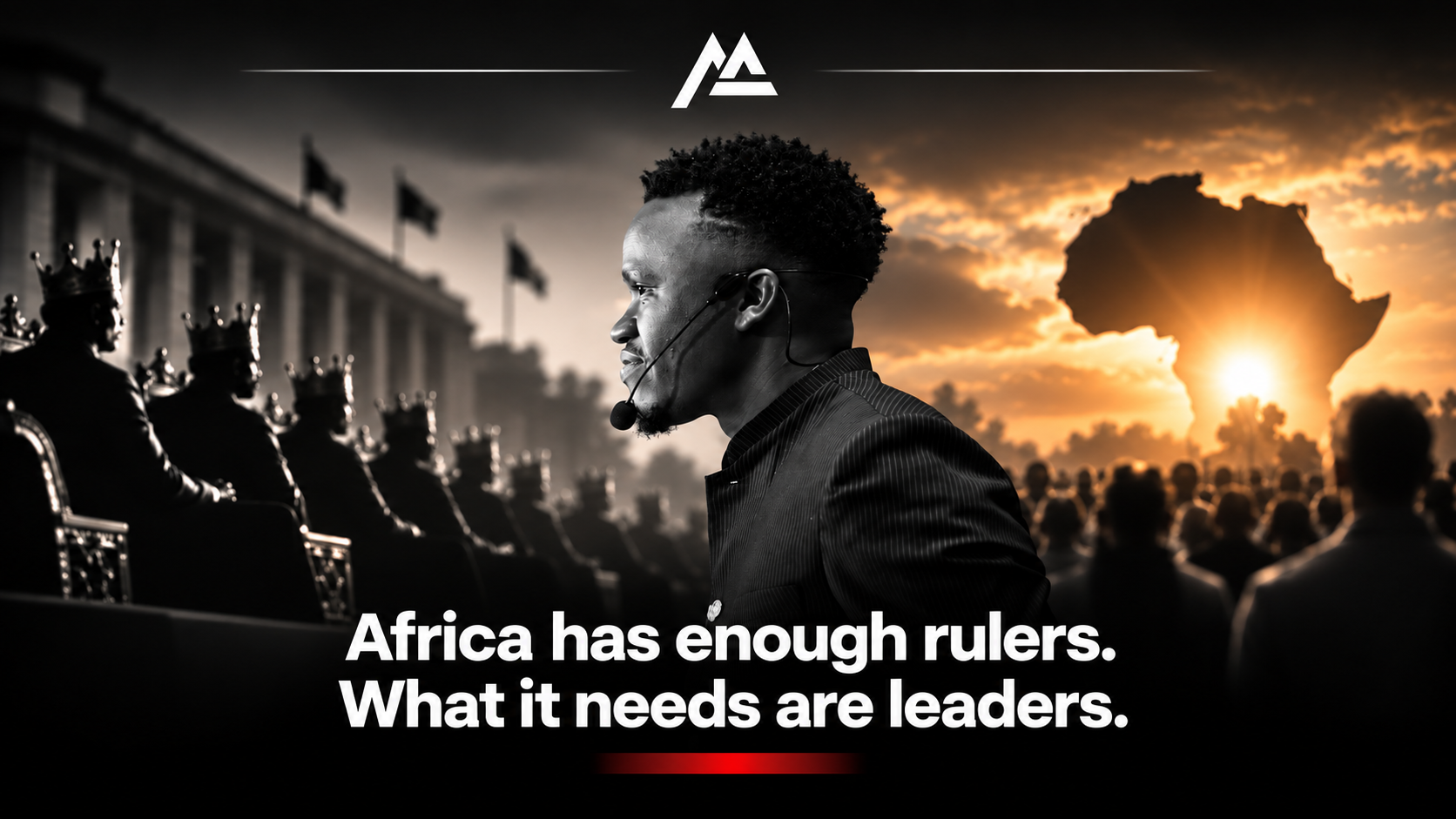
Africa Has Enough Rulers. What It Needs Are Leaders.
Fame can give you attention, but it cannot give you leadership. A title can give you authority, but it cannot give you influence. Leadership is not about being seen. It is about purpose, responsibility and the ability to move people toward a greater mission. Africa does not need more people seeking positions. It needs people prepared to lead.
In an age dominated by social media, visibility has become one of the most powerful currencies in society. A person can accumulate millions of followers, command attention across continents and become a household name without necessarily possessing the qualities required to lead.
This distinction matters.
Leadership is not fame.
Leadership is leadership, and fame is fame.
The two can coexist. A leader can become famous, and a famous person can eventually become a leader. But fame itself does not produce leadership. Popularity does not automatically create wisdom, character, vision or the ability to move people toward a meaningful purpose.
We should stop confusing visibility with leadership.
Not everyone who appears good is necessarily equipped to lead. History offers examples of people whose public image did not correspond neatly with the quality of their leadership. There have also been people who appeared admirable yet produced deeply damaging outcomes when entrusted with responsibility.
This tells us something important: leadership is deeper than appearance.
It is deeper than charisma, clothing, eloquence, intelligence, wealth or the ability to command a room.
A person can possess all of these qualities and still fail to lead.
The difference between ruling and leading
One of the most important distinctions we need to make is between ruling and leading.
Ruling can mean that your authority makes your words law. Leadership is different. Leadership depends fundamentally on influence.
A ruler may be obeyed because people have to obey.
A leader is followed because people choose to follow.
That distinction changes everything.
When people genuinely believe in a vision, understand their role in it and trust the person communicating it, they can produce results that exceed what any individual could accomplish alone.
Leadership, therefore, is not simply the possession of authority. It is the ability to mobilize people around purpose.
This is why a title cannot create a leader.
A chair cannot create a leader.
A position cannot create a leader.
A large following cannot create a leader.
Even a government office, corporate position or institutional title cannot, by itself, create leadership.
The position may give someone authority. What they do with that authority determines whether they are actually leading.
Africa’s leadership question
For Africa, this distinction deserves serious attention.
When we discuss the continent’s challenges, we often focus on institutions, economies, infrastructure, education, resources and political systems. These are important questions. But underneath many of them sits another question:
What kind of leadership are we producing?
My concern is not that Africa has no leaders. It is that we too often define leadership by position rather than by purpose, influence and results.
Someone can occupy an important office without possessing a leadership mentality.
Someone can have a title without having a vision.
Someone can have authority without having influence.
And someone can have influence without understanding the responsibility that comes with it.
The result is a dangerous confusion: we begin to call people leaders simply because they are in positions where leadership is expected.
Perhaps one of the most important tasks for Africa is therefore not merely to find people to place in positions of responsibility, but to identify, develop and prepare people who genuinely understand leadership.
That requires us to teach leadership before we celebrate leadership.
Leadership as a calling
I understand leadership not merely as a skill but as a calling.
For me, leadership is connected to purpose—a responsibility to accomplish something larger than oneself.
This is where my understanding of leadership becomes spiritual.
Within my Christian worldview, leadership begins with God. Leadership is therefore not simply about what a person wants to become; it is about understanding what they have been called to accomplish and whom they are called to serve.
A leader must therefore ask difficult questions:
Who called me?
What have I been called to do?
Who am I called to serve?
What is the mission?
And perhaps the most uncomfortable question:
Am I actually living the calling I claim to have received?
These questions move leadership away from self-promotion and toward responsibility.
Leadership becomes less about “Look at me” and more about “What am I here to accomplish?”
Knowing what you cannot do
Leadership is also not about knowing everything.
In fact, one of the marks of mature leadership is knowing what you do not know and recognizing what you cannot do alone.
A leader who understands their limitations can build a team capable of achieving what the leader personally cannot.
That requires humility.
It requires wisdom.
And it requires the ability to trust other people.
The strongest leaders are not necessarily those who can do everything themselves. They are often those who can recognize the right people, give them responsibility and bring their different abilities together around a common mission.
This is where leadership becomes more than knowledge.
Knowledge tells you what you know.
Wisdom helps you know what to do with what you know.
Leadership takes that wisdom and turns it into action and results through people.
The danger of confusing charisma with character
The modern world has made charisma incredibly powerful.
We are drawn to people who speak well, dress well, look confident and communicate effortlessly. Social media has amplified this even further. A carefully produced image can create the appearance of authority long before a person’s leadership has ever been tested.
But leadership cannot be fully measured by presentation.
Eventually, responsibility exposes what popularity conceals.
A person’s leadership is tested when circumstances become difficult, when people disagree with them, when resources are limited, when failure occurs and when there is no applause.
That is when leadership moves from performance to substance.
The question is no longer:
How many people are watching you?
The question becomes:
What happens to the people who follow you?
Leadership begins when responsibility begins
Leadership does not begin when you receive the biggest title in the room.
It begins with the first opportunity you are given to take responsibility.
A small team can teach leadership.
A business can teach leadership.
A family can teach leadership.
A community can teach leadership.
An institution can teach leadership.
The size of the platform is not the beginning of leadership. Responsibility is.
Whatever is inside a person eventually begins to reveal itself when responsibility is placed in their hands.
That is why leadership should be developed long before someone reaches the highest office.
We should not wait until someone has power to ask whether they know how to use it.
We should ask the question much earlier.
So, are you a leader?
For anyone who wants to lead—and for anyone who already occupies a leadership position—I would leave four questions:
Have you been called?
Who called you?
Do you understand the mission you were called to pursue?
Are you living that calling?
These questions may challenge you.
They may even force you to reconsider the position you currently occupy.
But perhaps that is exactly what leadership requires.
Because leadership is not a chair.
It is not a title.
It is not a position.
It is not fame.
It is not charisma.
Leadership is a calling to serve a purpose greater than yourself.
And perhaps Africa’s next leadership revolution will not begin when we find more famous people.
Perhaps it will begin when we learn to recognize the difference between being known and being called, being powerful and being influential, holding a position and actually leading.
Leadership is not fame.
Leadership is responsibility. Leadership is influence. Leadership is purpose. Leadership is a calling.
— Mika Chavala

Comments
Join the conversation. You can comment anonymously.
Loading comments…